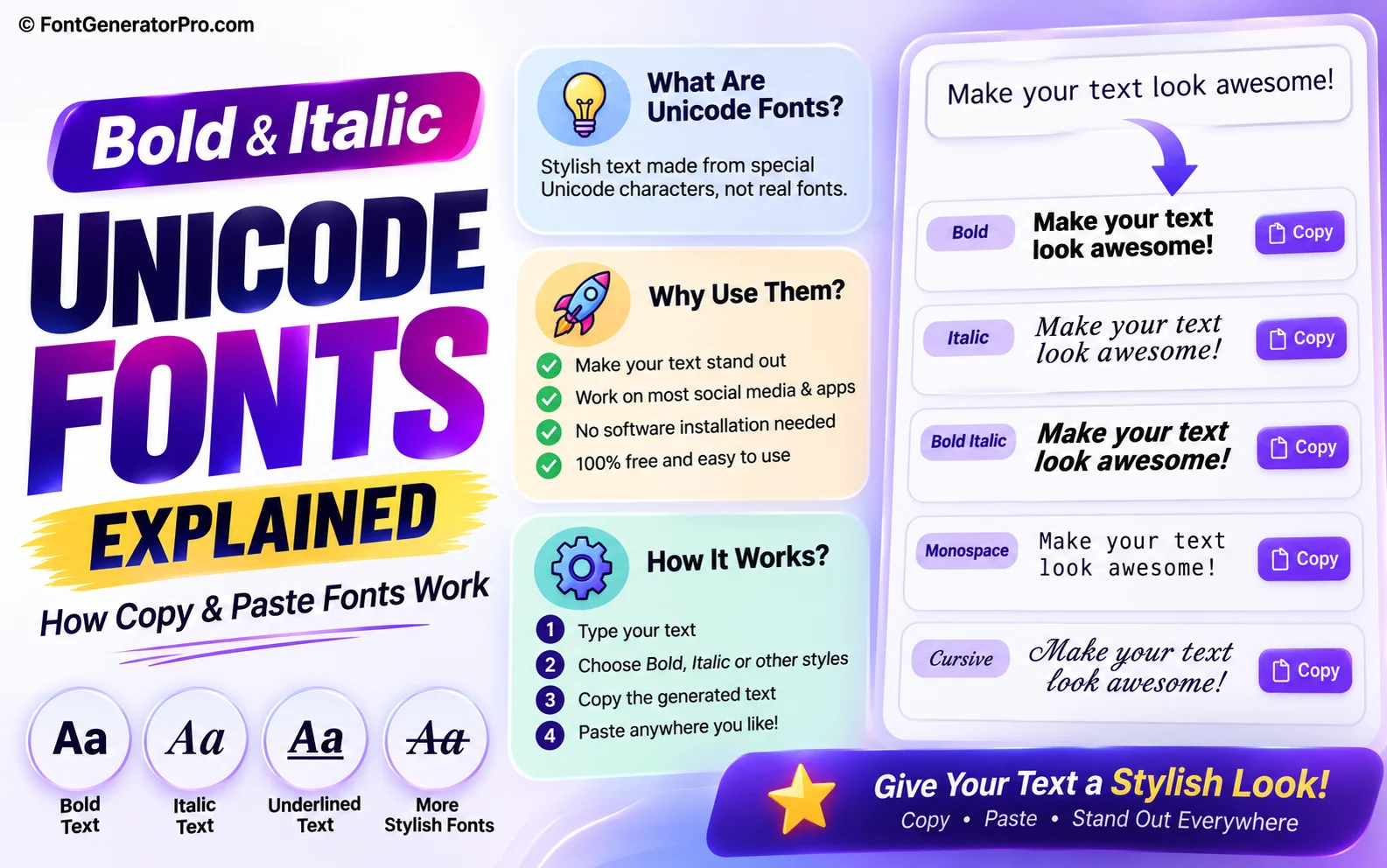
When you paste "bold" or "italic" text into a place that doesn't normally support text formatting — a bio, a tweet, a WhatsApp status — you're not applying a style to your existing letters. You're substituting each letter for a completely different character that happens to look bold or italic. Understanding that distinction explains almost every quirk these fonts have.
The Mathematical Alphanumeric Symbols block
Unicode set aside a dedicated range (U+1D400 to U+1D7FF) originally intended for mathematical notation, where bold, italic, script, and Fraktur letterforms carry real mathematical meaning — for example, distinguishing a scalar from a vector or a set. Font generators repurpose this block cosmetically: your "T" becomes 𝗧 (a completely different character, not styled "T"), and every app that renders Unicode text displays it as bold automatically, no formatting required.
Why this isn't the same as "real" bold text
True bold formatting — like in a Word document or an HTML <strong> tag — keeps the same underlying letter and only changes how it's drawn. Unicode bold text changes the letter itself. That's why:
- Screen readers may announce it strangely or skip it, since it's not recognized as the letter "T," just a math symbol that looks like one.
- Search engines and in-app search often can't match it against normal text, hurting discoverability if used for keywords.
- It doesn't inherit surrounding formatting — you can't make Unicode bold text "more bold" or underline it through normal formatting tools.
Why numbers and punctuation sometimes stay normal
The Mathematical Alphanumeric block doesn't fully cover every character — some styles have bold digits, others don't, and almost none include bold punctuation. That's why a styled sentence often has normal-looking commas, periods, or question marks sitting next to bold letters: those characters were never given a bold equivalent in Unicode, so the generator leaves them as-is.
When copy-paste bold/italic is worth using
It's a great fit for short, decorative, one-off text: names, bios, taglines, and social captions where visual impact matters more than accessibility or searchability. It's a poor fit for body text, official documents, or anything a screen reader or search index needs to parse correctly — use real formatting (bold tags, Markdown, a word processor's Bold button) for those instead.
Try it in the font generator
Type your text once and preview every style from this guide side by side.
Open the Font GeneratorFrequently asked questions
Is copy-paste bold text technically a font?
No. It uses separate Unicode characters from the Mathematical Alphanumeric Symbols block, not a font file — the bold appearance is baked into the character itself, not applied as a style.
Why does copy-paste bold text look different on Windows vs. iPhone?
Both devices are rendering the exact same Unicode character, but with a different system font, which can make stroke weight and letter shape look slightly different — the underlying character never changes.
Can screen readers read Unicode bold text properly?
Support varies by screen reader and platform. Some announce the character correctly, others skip it or read it oddly, since technically it's a math symbol rather than a recognized letter — a real accessibility trade-off worth knowing about.
Why doesn't bold italic Unicode text include every letter?
Unicode's Mathematical Alphanumeric block is large but not infinite, and a handful of legacy math symbols already occupied a few of the "expected" slots, leaving small gaps that font generators substitute with the closest available character.
Should I use Unicode bold for SEO-important text?
No — use it for decorative or short text only. Search engines generally can't match Unicode-styled characters to normal search queries, so important keywords should stay in plain text.